By John Limbach
August 2, 2026
On an overcast, drizzly afternoon in Portland, Oregon, on November 24, 1971, passenger Bill Mitchell, a 20-year-old sophomore at the University of Oregon, had his whole adult life ahead of him. He was the last to board and, as history would have it, sat on the opposite side of the aisle in the same last row as the now-infamous hijacker.
A man using the name D. B. Cooper boarded the commercial flight from Portland to Seattle, Washington, claiming to have a bomb. After extorting $200,000 in ransom and four parachutes, he released the passengers in Seattle and ordered the aircraft to take off again. Somewhere over the Pacific Northwest, Cooper parachuted from the plane into the night and was never conclusively identified or found. Despite one of the longest and most famous investigations in U.S. history, the case remains officially unsolved and has become a lasting American mystery.
Nobody knows whether the hijacker had a real bomb in his briefcase when he boarded Northwest Orient Airlines Flight 305, a Boeing 727-100 series aircraft. But it looked real enough to the two flight attendants who saw the red sticks bundled with tape attached to a battery by a wire.
Mitchell became emotional during an onstage interview at the annual D.B. Cooper Con held last November at the Kiggins Theatre in Vancouver, Washington—the area where Cooper is believed to have jumped from the aft stairs of the aircraft and where $6,000 of the $200,000 in ransom money was found nine years later along the bank of the Columbia River at a place called Tena Bar. Bill’s eyes welled up, and he struggled to speak for a moment as he talked about his grandchildren. He reflected on how differently his family’s future might have unfolded if the hijacking had ended another way.
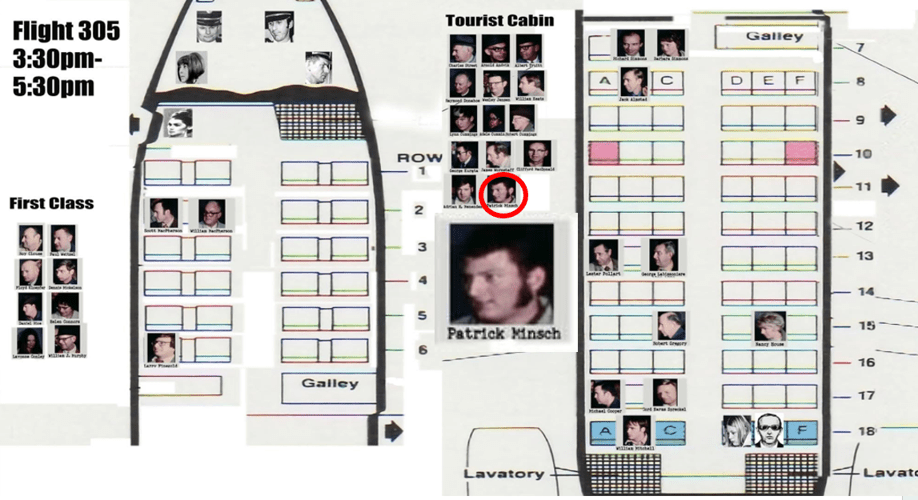
But Mitchell was not the only college-aged young man on the flight. Rows ahead in the coach section, before the first-class compartment, sat another young man who hailed from Washington and lived in Anchorage, Alaska. He, too, was returning home for Thanksgiving to the area where he grew up in Washington—first in Bellingham and then in Friday Harbor.

Images used from Ryan Burns, D.B. Cooper Sleuth on YouTube
While the hijacker’s actions would be stealthily communicated to the cockpit by the flight attendants—first Florence Schaffner and then Tina Mucklow- that other young man, who was the same age as Bill Mitchell, was oblivious to the changed circumstances now delaying his trip home to enjoy the holiday weekend with family. That family included his father, Alan “Micky” Minsch. Micky had served in the Navy in the South Pacific and then settled in Friday Harbor, where he met and married schoolteacher Lois Wehrly. They would move from Friday Harbor to Boise, Idaho, and then to Alaska, where Alan worked for the FAA until retirement. Alan and Lois had five children. One would follow in Micky’s footsteps by working for the FAA—his son Patrick.
Like Bill Mitchell, Patrick “Pat” Minsch also had his whole adult life in front of him when he boarded Flight 305 on Thanksgiving Eve in 1971. He, too, was looking to complete his studies and continue his journey toward a career in aviation with the FAA as an air traffic controller in Alaska.
Like all aboard Flight 305 except the hijacker, Pat was expecting a short flight to Seattle. He would have the same experience as most of the passengers – especially those who sat more than a few rows ahead of the hijacker. Pat never left his seat to use the restroom or look back to see the man in the last row. He had no reason to since the hijacker made no disturbance during the flight to Seattle.
When the plane landed in Seattle, several passengers noted that they seemed far away from the gate. But like many who spoke to reporters after they reached the terminal, Pat had only thought the flight was delayed due to the precaution that was announced to them in the air.
The flight crew, knowing they would need to remain airborne while authorities on the ground scrambled to collect four parachutes and the ransom money, had been instructed by Cooper not to land until the items were ready to be brought onboard. If all went well, he promised to release the passengers in Seattle. The flight crew also received word that their airline’s president had instructed them to fully cooperate with the hijacker based on the odds that neither they nor the passengers would be harmed and the aircraft would be left undamaged if they did so.
First Officer Bill Rataczak announced to the passengers that landing was delayed due to a “minor mechanical difficulty.” The plane was flying smoothly, and one passenger remarked that Rataczak’s voice was so comforting and professional that they had no reason for concern, except for the time delay that turned minutes into hours.
Minsch, having been immersed in the “family business”, shrugged it off as just another protocol delay. It was only upon landing and after Tina Mucklow brought the ransom items onboard that Cooper allowed the passengers to exit the aircraft as promised. Pat was then made aware of what had transpired.
When reporters questioned the passengers in the terminal, it was Pat who replied, “The crew just said something might be wrong with the plane.”
Like other passengers who never interacted with the hijacker, he also shared, “We had no idea there was a hijacking involved until we were off the plane.”
As with Bill Mitchell, life went on. But unlike Mitchell, who continued to be visited by the FBI and the media to discuss the case and look at suspect photos, Minsch would not be contacted again because there was nothing he could add to the limited statements he had already made in the Sea-Tac terminal that evening.
Minsch simply did not experience a terrifying incident that day unlike others he would hear about and experience, so while the D.B. Cooper mystery would take on a life of its own as the only unsolved hijacking in United States history, it did not take up any more space in his life.
In fact, much like the air traffic controllers who monitored and directed Flight 305, Pat would go on to receive commendations after some harrowing events he experienced firsthand as an air traffic controller. He received several letters of commendation and a Special Achievement Award for assisting distressed aircraft. In one instance, he guided an aircraft safely to the ground when it was running out of fuel. In another, he helped divert a jet for an emergency landing after a passenger suffered a heart attack and needed immediate medical attention.
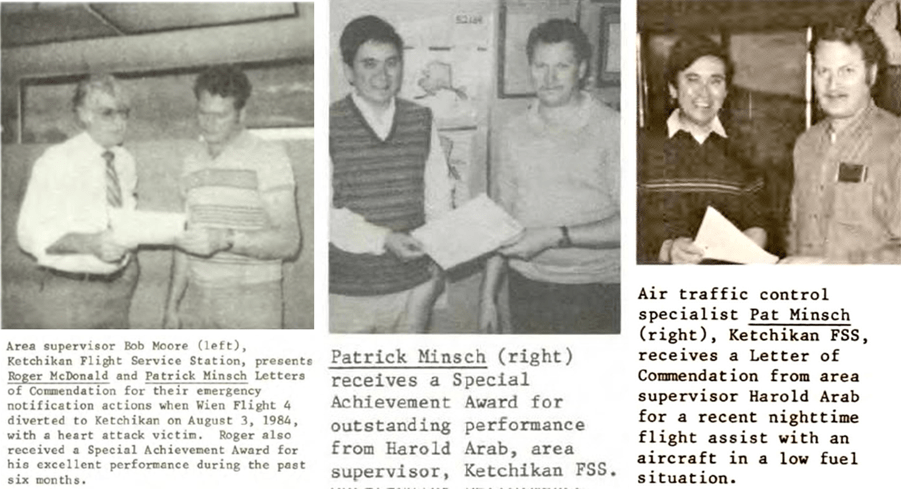
Photos of Pat Minsch receiving commendations for his excellence in air traffic control. Source: Intercom, Department of Transportation/FAA.
Pat is now 74 and resides with his wife Josephine in Juneau, Alaska. He is retired but maintains his association with the FAA.
The hijacking of Flight 305 was a significant event for Minsch to be part of, but not one that appears to have left a significant mark on his life or aviation career with the FAA. 2010 was a particularly tough year. Pat lost his brother Michael, a long-time Alaska aviator. Michael succumbed to cancer at age 60, and his service was held at the Alaska Aviation Museum. Shortly thereafter, his beloved father Alan passed away.
After tracking down Pat last month, it is clear that, like other surviving passengers and crew members, he is not interested in responding to media requests. While he was a witness to history, he was not an eyewitness who could help identify the man who delayed his Thanksgiving Eve dinner in 1971.
So this short story becomes a footnote and trivia in the folklore surrounding the unsolved mystery of who the hijacker was. There was another 20-year-old man on the flight in addition to Bill Mitchell. And there was an air traffic controller aboard N467US, the Boeing 727 that an unidentified criminal made famous that day. I wish Pat Minsch a long and happy retirement far away from the public interest in the D.B. Cooper mystery and aviation emergencies. He has given enough for both.
John Limbach is a businessman and the author of a Cooper-related nonfiction book, Where Was Skip? – available on Amazon. Limbach and Ryan Burns are owners of the annual D.B. Cooper Conference. You can find them both on Facebook by joining The Official D.B. Cooper Group.


Leave a Reply